Your team should be looking at patients, not at paperwork.
One system for the whole eye hospital — workup, prescription, theatre and billing on the same record. The OPD keeps moving, and your staff get to look up from the screen.
OPD live · Unit 1
Representative data| Token | Department | Status |
|---|---|---|
| A-118 | Retina | Dilating |
| A-119 | Cataract | Registered |
| A-120 | Optical | Appointed |
A-119 · refraction accepted
- ODRight
- −2.25 / −0.75 × 175
- OSLeft
- −2.00 / −0.50 × 010
ADD +2.00 — glass Rx ready at the optical counter
- Refraction to glass Rx
- IOL batch & expiry
- Anti-VEGF schedules
- Eye-OT & safety checklist
- WhatsApp reminders
- Every branch, live
A calmer day, from the first token to the last bill
Most eye hospitals lose the day in the gaps — between the machine and the file, the file and the counter, the counter and the accounts. Aviral closes them.
- 01
The front desk stops guessing
Online booking, self-registration and a live OPD queue. Patients arrive expected, not announced.
- 02
The doctor sees the whole eye
Refraction, IOP, slit-lamp, fundus, investigations and past surgeries on one case sheet — not four registers.
- 03
The patient comes back
Automatic WhatsApp reminders two days ahead, and a recovery call-back list so a missed follow-up gets noticed.
One patient, one day, six desks
Nothing below is re-entered. Each desk writes to the same record, and the next one picks it up.
One case sheet · cataract, right eye
Representative data08:42
Front desk
Booked online, arrives, joins the queue
Self-registration means the record already exists. Reception confirms and adds them to the live OPD queue.
Token A-14 · waiting 14 min
09:10
Optometry
Four vision tests per eye, then acceptance
Auto-refractor readings come in objectively; the optometrist records the accepted values against them.
OD −2.25 / −0.75 × 175
09:35
Doctor's desk
The whole eye on one case sheet
Workup, IOP, slit-lamp and past visits together. OCT ordered, prescription pre-loaded from a template.
IOP 14 / 15 mmHg
10:05
Counselling
Surgery explained, advance taken
The counsellor logs the session, gives a written estimate and collects a deposit that locks against the procedure.
₹38,070 paid of ₹63,070
11:30
Theatre — next day
Checklist cleared, lens issued from stock
The safety checklist runs before induction, before incision and before the patient leaves. The IOL leaves inventory against this patient.
HOYA Vivinex Impress · +23.5 D
D+1
Recovery
Follow-up booked before they forget
Discharge instructions go out on WhatsApp automatically. If the follow-up is missed, they appear on the call-back list.
Follow-up 19 Aug
Six desks, one record — nothing above was typed twice.
Built for eye care. Not adapted for it.
The parts a general hospital system doesn't have — and the reason an eye hospital outgrows one.

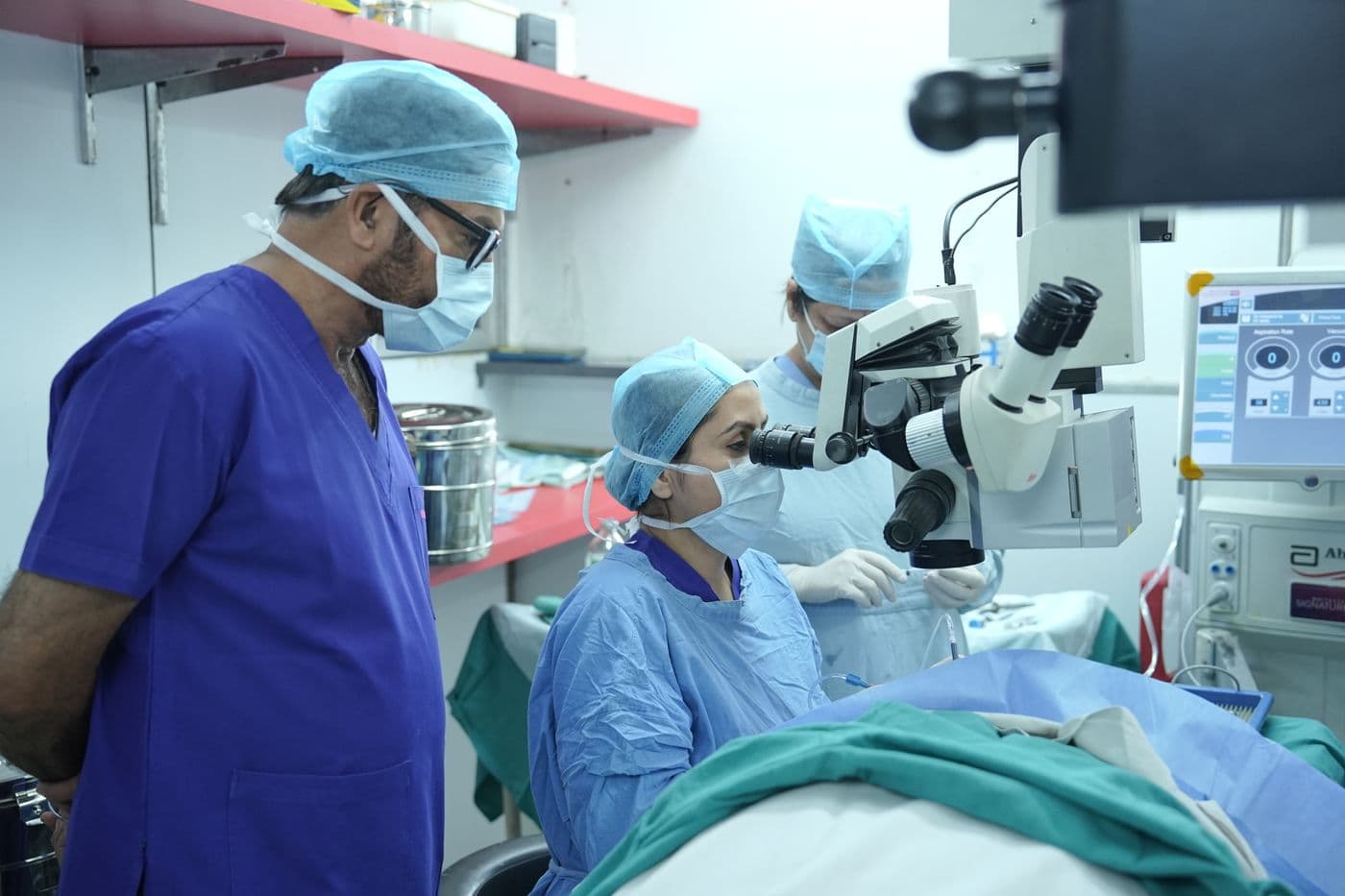
Refraction
The workup writes the prescription
Accepted refraction values become the glass Rx. Nobody re-types SPH, CYL or AXIS at the optical counter.
SPH · CYL · AXIS · ADD · Accepted VA
Implant
Every IOL traced to a patient
Brand, power, batch and expiry recorded at implant. A recall becomes a search, not a store-room afternoon.
Brand · Power · Batch · Expiry · Eye
Injection series
The injection series on one screen
Intravitreal and anti-VEGF doses logged by eye, drug and date, with the next due date on the record.
Eye · Drug · Dose no. · Next due
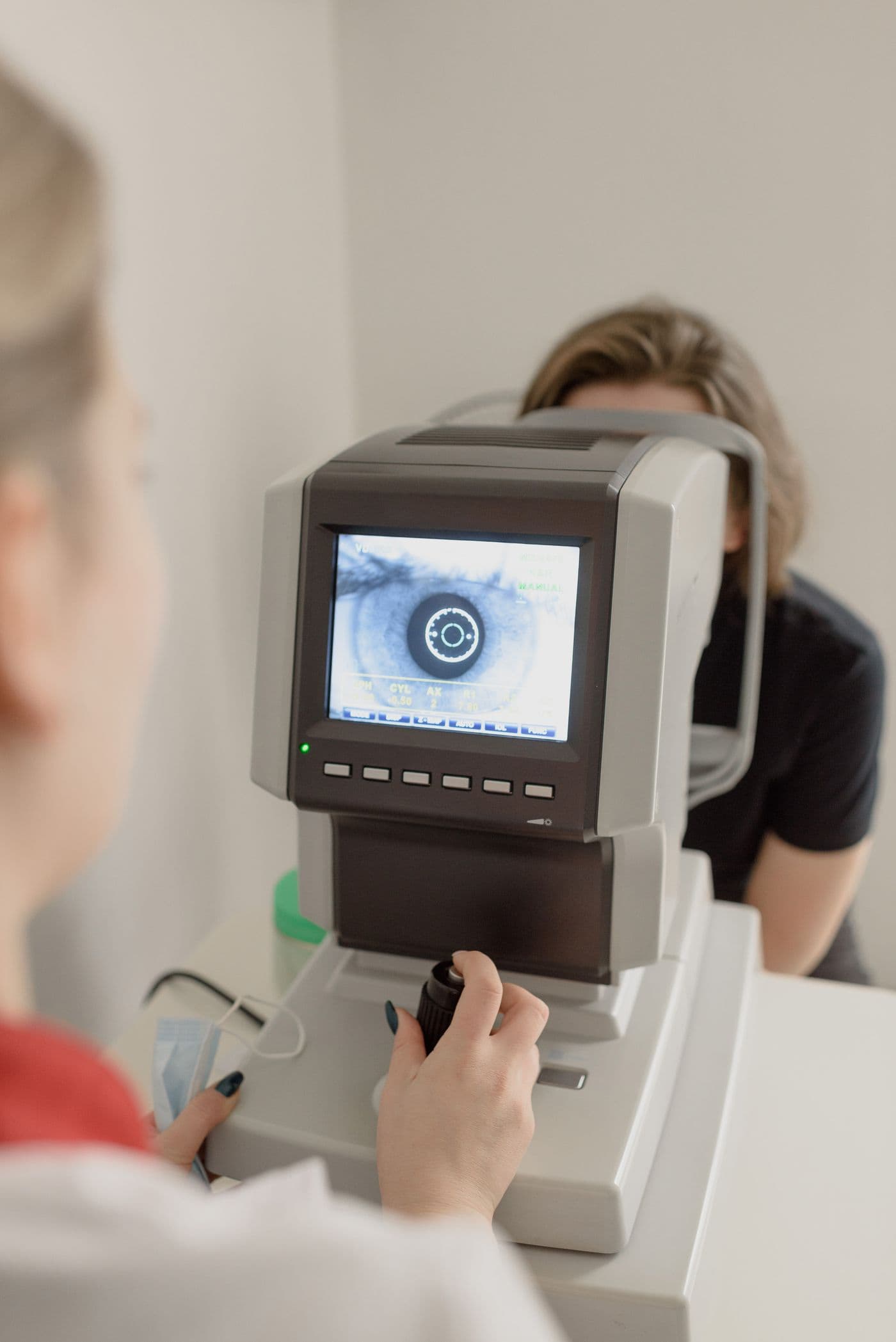
Devices
Machines write into the record
AR, OCT and pachymetry readings land in the investigation record, then flow through to the bill.
AR · OCT · Pachymetry
None of these are custom fields bolted onto a general system. They are how the record is built.
Four things a general system won't do for you
These are the mechanisms hospitals ask us to demonstrate first.
- 01Finance
The Hospital Wallet holds an advance, not just receives it
A deposit is locked against a specific procedure, spent as it is billed, and whatever is left releases back automatically. No disputed advances, no reconstructing what a patient paid for six months later.
Deposit takenLocked to the procedureSpent as billedBalance released
- 02Safety
The surgical checklist can't be skipped
The WHO checklist runs at all three stages — before induction, before incision, and before the patient leaves theatre. Twenty checks, recorded against the case rather than signed off on paper afterwards.
Before inductionBefore incisionBefore leaving theatre
- 03Devices
From machine to bill without a keyboard
Auto-refractor, OCT and perimetry output lands in the investigation record, and the charge appears on the invoice. Nobody reads a printout aloud to somebody typing.
Machine readingInvestigation recordInvoice line
- 04Finance
Doctor revenue-share, computed not reconstructed
Surgeon and consultant shares are calculated from what was actually billed, as it is billed — so month-end is a report, not an argument.
Bill raisedShare computedMonth-end report
Every branch. One day-book.
Each unit keeps its own patients, stock and ledgers. Chain management sees all of them live — without a nightly export.
- Branch-isolated records — patients, stock and ledgers stay separate
- 15 roles, permissioned module by module
- Branch switching at login for multi-unit staff
| Branch | OPD | OT | Collected |
|---|---|---|---|
| Unit 1 | 84 | 6 | ₹3,82,400 |
| Unit 2 | 61 | 3 | ₹2,44,150 |
| Unit 3 | 47 | 2 | ₹1,91,700 |
| Unit 4 | 39 | 4 | ₹2,06,900 |
| All branches | 231 | 15 | ₹10,25,150 |
Everything an eye hospital runs on
Five pillars, one record underneath. Nothing here is a separate system you have to reconcile at the end of the month.
Eye-specialty clinical
16AR workup to OT — ophthalmology is the foundation, not an add-on.
- Patient registration & MRD
- Appointment scheduling
- Live OPD queue
- Optometry & AR workup
- Glass prescription
- IOP, slit-lamp & fundus
- OPD consultation
- Doctor consult & templates
- +8 more
Quality & safety
12Surgical checklists, incident RCA/CAPA, sterilization recall, records audit — built in.
- WHO surgical safety checklist
- Incident reporting + RCA/CAPA
- Quality-committee module
- Daily safety checklists
- Staff training & SOPs
- +7 more
Multi-branch control
6One system across every unit; data scoped per branch, always.
- Multi-unit architecture
- 15-role RBAC
- Branch switching
- Color-coded dashboards
- Master data management
- +1 more
Operations & finance
14Billing, wallet escrow, pharmacy, stock, payroll — one ledger underneath.
- OPD billing
- IPD billing
- TPA / insurance billing
- Credit billing & reconciliation
- Hospital Wallet / escrow
- +9 more
Engagement & growth
10Online booking, WhatsApp automation, recovery worklists — the OPD stays full.
- Online appointment booking
- Online self-registration
- Recovery CRM
- WhatsApp automation (WATI)
- Pincode-based CRM
- +5 more
Where an eye hospital outgrows a general system
Most hospital software can hold an eye department. Very little of it can hold how an eye department actually works.
| Capability | Aviral Medcare | A general hospital system |
|---|---|---|
| Refraction workup | AR and acceptance captured as structured values, per eye | A free-text note |
| Glass prescription | Auto-filled from the accepted values and printed at the counter | Re-typed by hand |
| IOL implant record | Brand, power, batch and expiry tied to the patient for life | A line in the surgery note |
| Injection series | Logged by eye, drug and date, with the next dose due | A separate register |
| Eye theatre | Surgeon list, consumables and the safety checklist on the case | A generic OT module |
| Diagnostic machines | AR, OCT and perimetry write into the record | Typed in from a printout |
| Optical counter | The prescription drives the sale and the stock | Disconnected from the exam |
This is a working system, not a pitch deck
15 years
Building software since 2011
35 people
Ebslon Infotech, in-house
Live today
Running the OPD, theatre and billing at Synergy Eye Center
We don't publish customer counts, logos or star ratings. When hospitals agree to be named, they appear here with their permission and not before.
Asked before every demo
The questions hospital owners and administrators put to us before they commit — migration, go-live, machines, branch access, training and cost. Answered here the way we answer them on the call.
Is this built for eye care, or a general system with an eye module?
Built for eye care. Refraction produces structured values rather than a note, the glass prescription is generated from the accepted workup, an implanted lens carries its batch and expiry against the patient, and an injection is tracked as a series. Those are foundations here, not additions.
Is Aviral Medcare an EMR, an EHR or a hospital management system?
All three, in practice. In India the terms EMR and EHR are used interchangeably for the clinical record; a hospital management system is the operational layer around it — registration, billing, stock, reporting. Aviral Medcare keeps the ophthalmic clinical record and the hospital operations in one system, so the distinction is a vendor's, not yours.
We already have years of data in another system. Can you bring it across?
Yes — patient records, stock and ledgers are migrated before go-live, not after. We look at what you have during scoping and tell you honestly what maps cleanly and what needs a decision from you.
How long does go-live take, and how much disruption should we expect?
It depends on how many branches and how much history you are bringing across, so we scope it before quoting a date. The sequence is always the same: configure and migrate, train role by role, then go live with our people on site for the first days.
Will our existing machines connect?
Auto-refractors, OCT and perimetry are the common ones, and biometric readers for attendance. Device support depends on the specific model and what it can output, so we check yours during scoping rather than promising universal compatibility.
Who owns our data, and can we get it out?
You do. Reports across every module export to Excel and PDF, and your records remain yours to take with you.
How do you stop one branch seeing another branch's records?
Records are scoped to a branch — patients, stock and ledgers never mix. Staff who genuinely work across locations switch branch at login, and every screen they reach is governed by their role's permissions.
What does training the staff actually involve?
Role by role, on the screens each person actually uses. The front desk learns registration and the queue; optometry learns the workup; billing learns the day-close. Nobody sits through a session about a module they will never open.
What does it cost?
It depends on your branches, users and which modules you need, so we scope before quoting rather than publishing a number that would be wrong for most hospitals. Tell us how your setup looks and you get a written scope and quote.
Guides for the people who run eye hospitals
Practical writing on choosing an ophthalmology EMR, running the IOL store room and what a hospital management system should actually do.
10 min read
What Is a Hospital Management System? A Plain-Language Guide
What an HMS actually covers, cloud vs on-premise, what it costs in India, and a short method for choosing one — with the specialty question answered honestly.
7 min read
IOL Inventory Management for Eye Hospitals: Batches, Recalls and the Store Room
Why intraocular lenses are not ordinary stock, what a proper IOL record tracks, and the two-minute recall test every eye hospital should be able to pass.
9 min read
Ophthalmology EMR Software in India: A Buyer's Guide for Eye Hospitals
What separates an eye-specialty EMR from a generic hospital system, the capability checklist to evaluate against, and the questions worth asking in any vendor demo.
See it running on your own hospital’s day
A live walkthrough of the real system — your refraction desk, your OT list, your billing day-close.
Full audit trail
Who changed what, when, and why — on every record.
Role-based access
View, create, edit and delete permissioned per module.
Branch-level isolation
Records are scoped to a branch and never mix.
Encrypted authentication
Token-based sessions with hashed credentials.